
Douglas ROMBUS (1966)
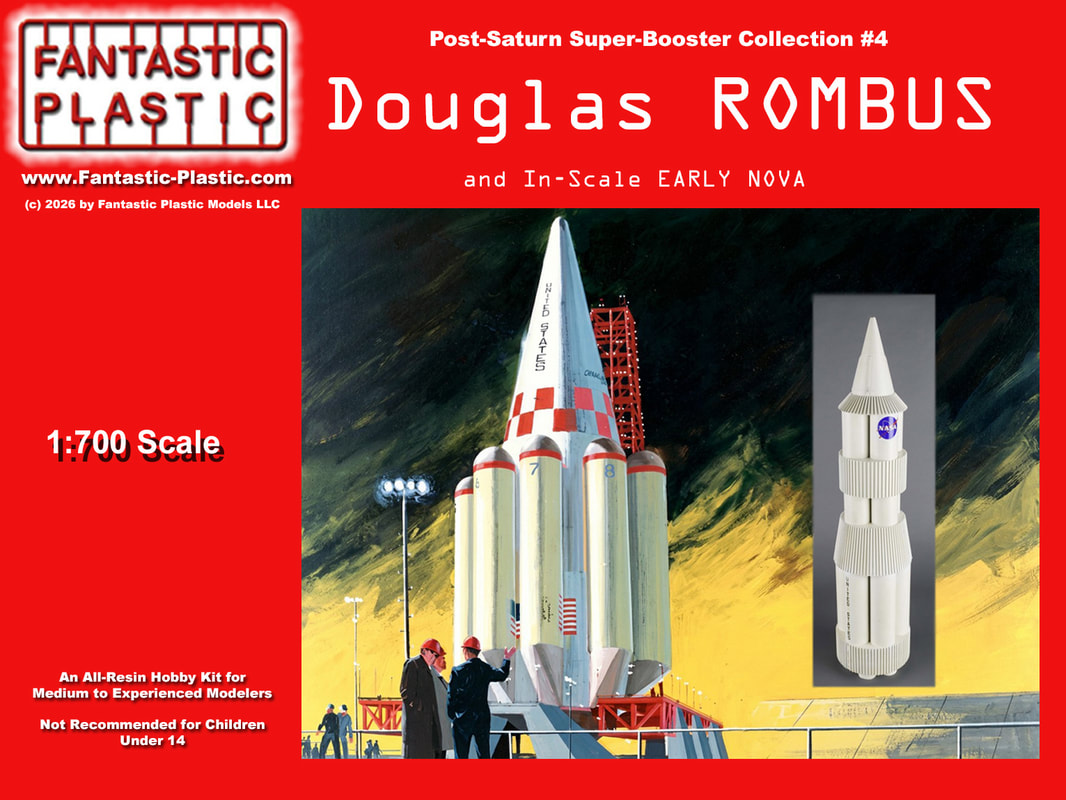
|

Scale: 1/700
Initial Release: 2026 Medium: Resin Kit Rarity: 2 |
About the Design
The Douglas ROMBUS (Reusable Orbital Module–Booster & Utility Shuttle) was a conceptual heavy-lift launch vehicle developed in the early 1960s, notably described by engineer Philip Bono around 1963. [2] It was envisioned as part of a broader effort to create fully reusable, low-cost space transportation systems during the early space race, when reducing launch costs and increasing payload capacity were major strategic goals.
ROMBUS’s primary purpose was to deliver extremely large payloads—on the order of hundreds of tons—into Earth orbit, supporting missions such as space stations, lunar operations, and deep-space exploration. Unlike conventional expendable rockets, it was designed to be recovered and reused, dramatically improving economic efficiency. The vehicle would have been flown as a single-stage-to-orbit (SSTO) craft using a cluster of plug-nozzle (aerospike) engines arranged around its base. It would launch vertically, ascend directly to orbit without staging, and then reenter Earth’s atmosphere. After reentry, it would perform a controlled descent and vertical landing, enabling rapid turnaround for subsequent missions. This fully reusable, SSTO approach was highly ambitious for its time and ultimately remained unbuilt. |
About the Kit
The ROMBUS is one of two kits included in Fantastic Plastic's 1:700 scale "Post-Saturn Super-Booster Collection #4), which was released in April 2026. The kit also included an in-scale Early Nova booster.
The kit's decal sheet allowed for a variety of markings. This model was built from the original issue. |